


TL/DR
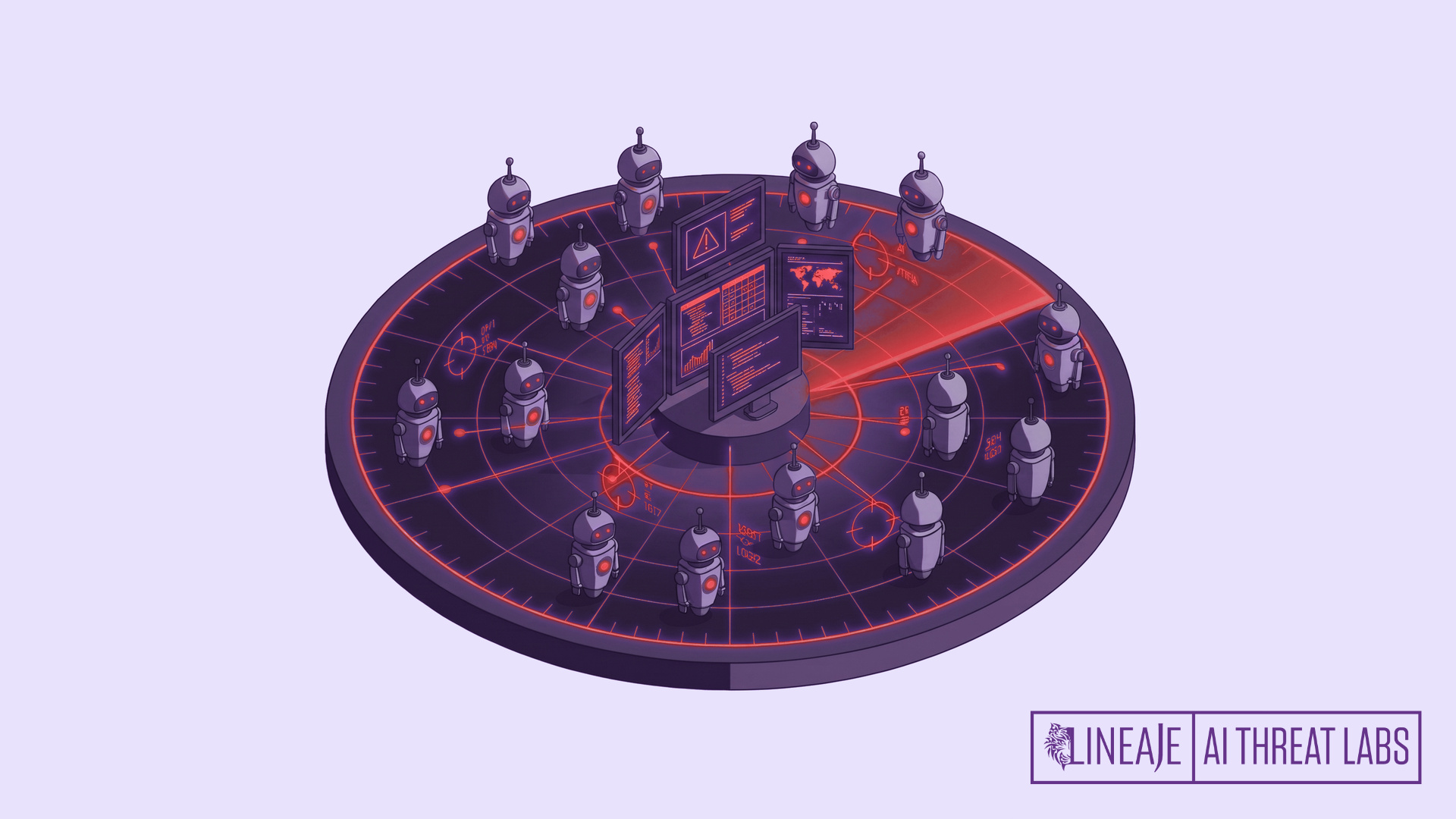
The BOSSAI campaign illustrates an evolution in AI enabled cyberattacks. A single operator used a network of specialized AI agents, models, MCP servers, and offensive security tools to conduct cyber operations across multiple countries. Acronis 12 configured AI agents were identified, nine active at the time of investigation, supporting reconnaissance, vulnerability identification, exploit development, and attack execution.
Lineaje Research assessment: BOSSAI is primarily an attack capability amplification incident, not a prompt injection incident. The attacker deliberately configured AI models and agents to pursue offensive objectives, granted broad tool access, and automated significant portions of the attack lifecycle.
The attack exposes 3 critical security concerns:
- Model safeguards are not execution boundaries. The operator used locally hosted models with safety alignment removed when commercial models refused offensive instructions.
- Tool access turns AI generated plans into executable attacks. MCP connected security tools enabled agents to conduct scanning, exploitation, credential extraction, and collection.
- Persistent skills and agent memory support operational continuity. Reusable attack procedures accumulated knowledge and evolved across sessions, reducing the need for repeated human direction.
The central Lineaje finding is that agentic autonomy combined with powerful tools and insufficient authorization boundaries can transform existing security weaknesses into scalable exploitation opportunities.
What Happened
Acronis Threat Research Unit investigated a coordinated AI assisted attack environment operated by one individual in Taiwan, examining more than 90,000 files and approximately 9 GB of evidence, including conversations, execution histories, configurations, credentials, and collected victim data.
The operator assembled specialized infrastructure and offensive agents rather than relying on a single assistant. The environment included commercial models for development and administration, locally modified models for offensive use, and MCP servers connecting agents to security and exploitation tools.
Logical workflow:
Human operator → infrastructure and offensive agents → MCP connected tools → external target systems.
In a documented workflow, HalberdStrike scanner scanned a Taiwanese emergency services target and produced a vulnerability report. The operator transferred results to Hermes for attack path analysis and then to Cursor for exploitation. Elsewhere, Hermes used Kali MCP tools to enumerate Thai university subdomains, identify SQL injection, extract a database username, enumerate an administrator table, and attempt student data extraction.
The operation was not uniformly successful. Commercial models repeatedly refused offensive requests, agents sometimes hallucinated vulnerabilities, encountered tool failures, or abandoned targets. The evidence does not establish reliable autonomous exploitation of every target.
Lineaje Research Assessment
1. The security boundary shifted from model behavior to agent capabilities
The operator controlled objectives, model selection, permissions, and connections to offensive tools. This makes BOSSAI different from a compromised legitimate assistant responding to adversarial content. The operative combination was autonomy, tool privileges, and reachable targets. Model output provided plans, MCP connected tools enabled execution, and exposed or vulnerable services determined exploitability.
2. Removing model safeguards is different from defeating them
The investigation provides an important distinction between bypassing safeguards and replacing them. Acronis Refusals by commercial models were observed. The operator responded by moving offensive workflows to locally hosted, abliterated models and configuring persistent instructions and automatic approvals. An abliterated model is an open weight LLM that has been modified to remove or reduce its built-in safety refusals. This is evidence of model substitution and permissive configuration, not proof of a successful jailbreak against every protected model. From Lineaje's perspective, this reinforces the importance of maintaining an enforceable authorization boundary between AI reasoning and the tools used to execute its decisions.
3. MCP transformed planning into external actions
The environment provided tools for scanning, exploitation, binary analysis, command execution, and automation. More than 3,300 terminal commands, 2,000 code execution calls, 500 file writes, and 129 Kali MCP invocations associated with Hermes activity were reported. Tool availability is not equivalent to tool authorization. Controls should account for tool, operation, destination, identity, data sensitivity, and task context. This represents an important enforcement opportunity for tool authorization, destination restrictions, and runtime policy controls enabled by UnifAI.
4. Persistent skills formed reusable attack workflows
Hermes maintained SKILL.md files and supporting scripts as durable procedures. The gov-api-penetration skill was invoked 51 times and modified 57 times. These artifacts preserved procedures and discoveries across sessions. This is significant because a skill is not merely reference material. It can influence future reasoning and define executable procedures. Skills should continuously be scanned, classified and restricted from unauthorized changes. An agent's capability can change even when its underlying model remains unchanged.
5. Goal integrity alone is insufficient; path integrity defines the security boundary
Goal integrity: The offensive agents generally pursued operator specified objectives. This was not principally a case of an adversary hijacking a legitimate agent’s goals.
Path integrity: The agents selected techniques and executed tools with broad discretion. In an enterprise agent, comparable behavior outside approved boundaries would be a path integrity failure.
Outcome integrity: Unauthorized access and extraction occurred at confirmed targets, while other attempts failed, stalled, or produced false findings. Outcomes must be distinguished by evidence.
The important security principle is that an agent can faithfully pursue its assigned objective while taking an unsafe or unauthorized path.
Lineaje AI Kill Chain Analysis

Lessons and Conclusion
BOSSAI demonstrates that AI enabled attacks can scale through orchestration, not necessarily novel exploits. Commercial and modified models, MCP connected tools, and persistent skills allowed one operator to automate reconnaissance and portions of exploitation but also produced errors and failed attempts. Existing weaknesses - exposed APIs, default credentials, outdated applications, and injection flaws - remained decisive.
Three lessons stand out from Lineaje’s research perspective:
Lesson 1: Separate model safety from authorization. Refusal behavior can reduce harmful participation, but action execution must be independently governed.
Lesson 2: Govern the connected AI ecosystem. The effective risk arises from relationships among models, agents, tools, skills, MCP servers, identities and destinations.
Lesson 3: Enforce path integrity. An agent may preserve a legitimate objective while choosing prohibited actions. Policy must constrain execution paths and outcomes, not only prompts.
Lineaje’s combined approach, AI component intelligence, model and skill classification, and UnifAI runtime policies, addresses the AI side execution risk when supported by application, identity, endpoint and network controls.
The defining challenge is no longer just whether an AI agent can generate an attack. It is whether the agent has the capabilities, privileges and unrestricted execution paths to carry it out.
