


AI regulations are expanding across countries, industries, and use cases. Requirements for transparency, risk management, human oversight, and security are becoming increasingly complex.
But compliance cannot stop at documentation. As AI agents make decisions, access data, and take action, organizations need governance that operates continuously.
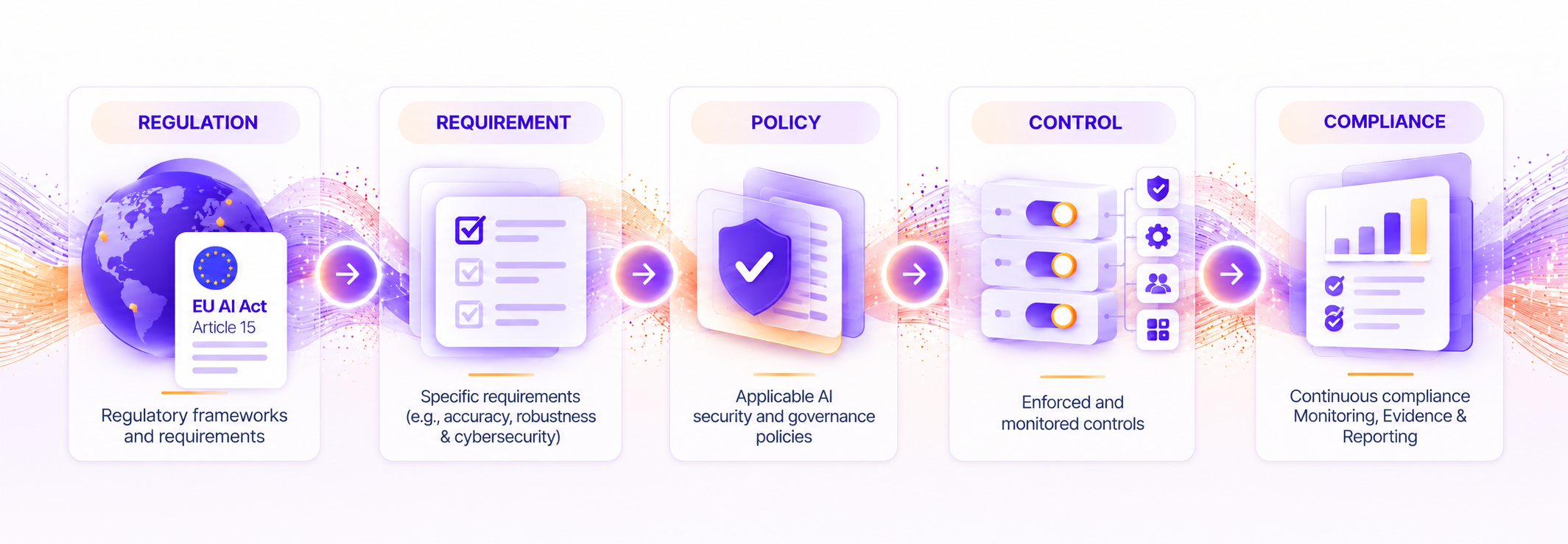
UnifAI helps organizations discover AI systems, translate regulatory requirements into policies, enforce controls, and demonstrate governance across AI operations.
DISCOVER → DERIVE → DEFEND → DEMONSTRATE
Traditional compliance programs were designed to assess systems, document controls, and demonstrate adherence at a point in time.AI changes that equation.Models evolve. Agents access new tools and data. Autonomous workflows introduce new behaviors and risks. And regulatory requirements vary across jurisdictions.
The challenge is no longer just knowing which regulations apply. It's ensuring AI continues to operate within those boundaries.
Organizations need to answer four critical questions:
What AI is operating across our environment?
Which regulations and policies apply?
What are our AI systems and agents allowed to do?
Can we demonstrate that those controls are being enforced?
Static assessments and policy documents aren't enough when both AI and the regulatory landscape are continuously changing.
AI compliance must move from periodic assessment to continuous governance.
1
DISCOVER
Identify AI models, agents, skills, MCP servers, tools, and connections operating across your environment. Establish visibility into the AI ecosystem and its potential exposure.
2
DERIVE
Connect applicable regulatory requirements and organizational policies to AI governance controls. Establish what AI systems and agents are permitted to access, decide, and do.
3
DEFEND
Apply security and governance policies across AI interactions, tool usage, data access, and agent actions. Detect and interrupt behavior that violates established boundaries.
3
DEMONSTRATE
Maintain visibility into AI activity, policy enforcement, and violations. Generate evidence that supports oversight, accountability, and compliance reviews.
UnifAI connects AI governance and security controls to the regulatory requirements organizations need to address.
Turn requirements into enforceable AI policies.
Regulations establish expectations for transparency, security, accountability, and human oversight. But defining a policy is only the beginning.
Lineaje UnifAI helps organizations connect those requirements to governance controls that can be applied across AI systems and agentic workflows.
Compliance is not just what your policies say. It's what your AI systems actually do.
Explore AI regulations, standards, and requirements across jurisdictions—and see how UnifAI helps operationalize compliance.

European Union AI Compliance
The EU AI Act establishes a comprehensive, risk-based framework for the development, deployment, and use of AI systems.
KEY FRAMEWORKS
EU AI Act
GDPR
NIS2 Directive


U.S.A Federal & State AI Compliance
A combination of federal, sector-specific, and state-level requirements governing AI systems and automated decisions.
KEY FRAMEWORKS
Federal: HIPAA, NIST AI RMF
State: Colorado AI ActState: Maryland Facial Recognition Law

Australia AI Compliance
Australia’s AI governance landscape spans the National Framework for the Assurance of AI in Government.
KEY FRAMEWORKS
Australia's AI Ethics Principles
Privacy Act 1988
AI Assurance Framework for Government

India AI Compliance
India’s AI security landscape includes national cybersecurity guidance addressing AI-assisted exploitation, digital infrastructure vulnerabilities, and defensive risk reduction.
KEY GUIDANCE
CERT-In AI-Assisted Vulnerabilities Blueprint (2026)

South Korea AI Compliance
South Korea’s AI legislation establishes a national framework for AI development and trust, including transparency, safety, and requirements for certain high-impact AI systems.
KEY LEGISLATION
AI Framework Act (Law No. 20676)

Japan AI Compliance
Japan’s national AI strategy emphasizes responsible AI development, innovation, governance, and the safe adoption of AI across government and industry.
KEY FRAMEWORK
Artificial Intelligence Basic Plan (2025)

China AI Compliance
China regulates generative AI services through requirements addressing content security, data protection, provider responsibilities, and the lawful provision of AI services.
KEY REGULATION
Interim Measures for Generative AI Services

Saudi Arabia AI Compliance
Saudi Arabia’s AI governance guidance supports responsible AI adoption through risk assessment, organizational readiness, oversight, and security considerations.
KEY FRAMEWORK
DAIA AI Adoption Framework (2025)

Vietnam AI Compliance
Vietnam’s AI legislation establishes a national framework for AI governance, with provisions addressing risk management, transparency, and responsibilities across AI development and deployment.
KEY LEGISLATION
Law on Artificial Intelligence (2025)
AI doesn't operate at a single point in time. Neither should governance. UnifAI transforms AI compliance from a point-in-time exercise into an operational process that continuously adapts as AI systems and requirements evolve.
Traditional compliance approaches focus on documenting requirements and reviewing controls periodically. AI systems and agents require governance that adapts as their behavior, access, and operating environments change.
This enables organizations to move from:
Unknown AI assets
AI visibility
Regulatory complexity
Requirement-level mapping
Written policies
Operational controls
Point-in-time reviews
Continuous assessment
Broad compliance claims
Documented evidence
AI Compliance That Never Stands Still.
From regulatory change to operational control, UnifAI keeps AI governance continuous—helping organizations adapt as requirements evolve, enforce the right controls, and maintain compliance over time.
AI compliance cannot stop at understanding regulations. Organizations need visibility into their AI, a way to determine what requirements apply, controls that can be enforced as AI operates, and continuous monitoring to maintain compliance as requirements evolve.
Discover your AI. Determine what applies. Enforce the controls. Demonstrate compliance.
See How UnifAI Operationalizes AI Compliance.
Assess Your AI Compliance →