

TL;DR
A recent investigation by RedAccess, summarized by WIRED revealed thousands of publicly accessible “vibe-coded” applications exposing sensitive corporate and personal information on the internet. These applications were rapidly created using AI-assisted development platforms capable of generating and deploying functional software directly from conversational prompts.
The incident was not a traditional cyberattack involving malware, exploit chains, or sophisticated intrusion tradecraft. Instead, the primary issue was insecure operationalization of AI-generated functionality. Conversational instructions were transformed into deployable applications that interacted with sensitive data, integrated with backend services, and exposed privileged functionality without sufficient authentication, authorization, or security-aware constraints.
This incident demonstrates a major shift in cybersecurity risk:
- AI is no longer merely generating code.
- AI is now generating deployable attack surfaces.
The result is AI-accelerated exposure at internet scale.
Core Exposure Pattern
This incident is important because it does not fit neatly into traditional cyberattack categories.
There was no malware deployment, exploit chain, memory corruption, advanced persistence or need for privilege escalation. Instead, the attack surface itself was unintentionally manufactured by AI-assisted systems.
The operational sequence looked more like this:
- Users supplied conversational instructions to AI development systems.
- The AI operationalized those instructions into deployable application behavior.
- The generated applications connected to sensitive business data and backend services.
- Weak or absent security controls exposed privileged functionality publicly.
- Publicly reachable applications became searchable, accessible, and queryable by anyone.
This was not primarily a “prompt injection” incident. The prompts themselves were often legitimate business requests. The problem was that the AI optimized for functional completion in the absence of secure operational boundaries.
The AI successfully completed the requested objective while unintentionally creating publicly exposed systems capable of leaking sensitive data.
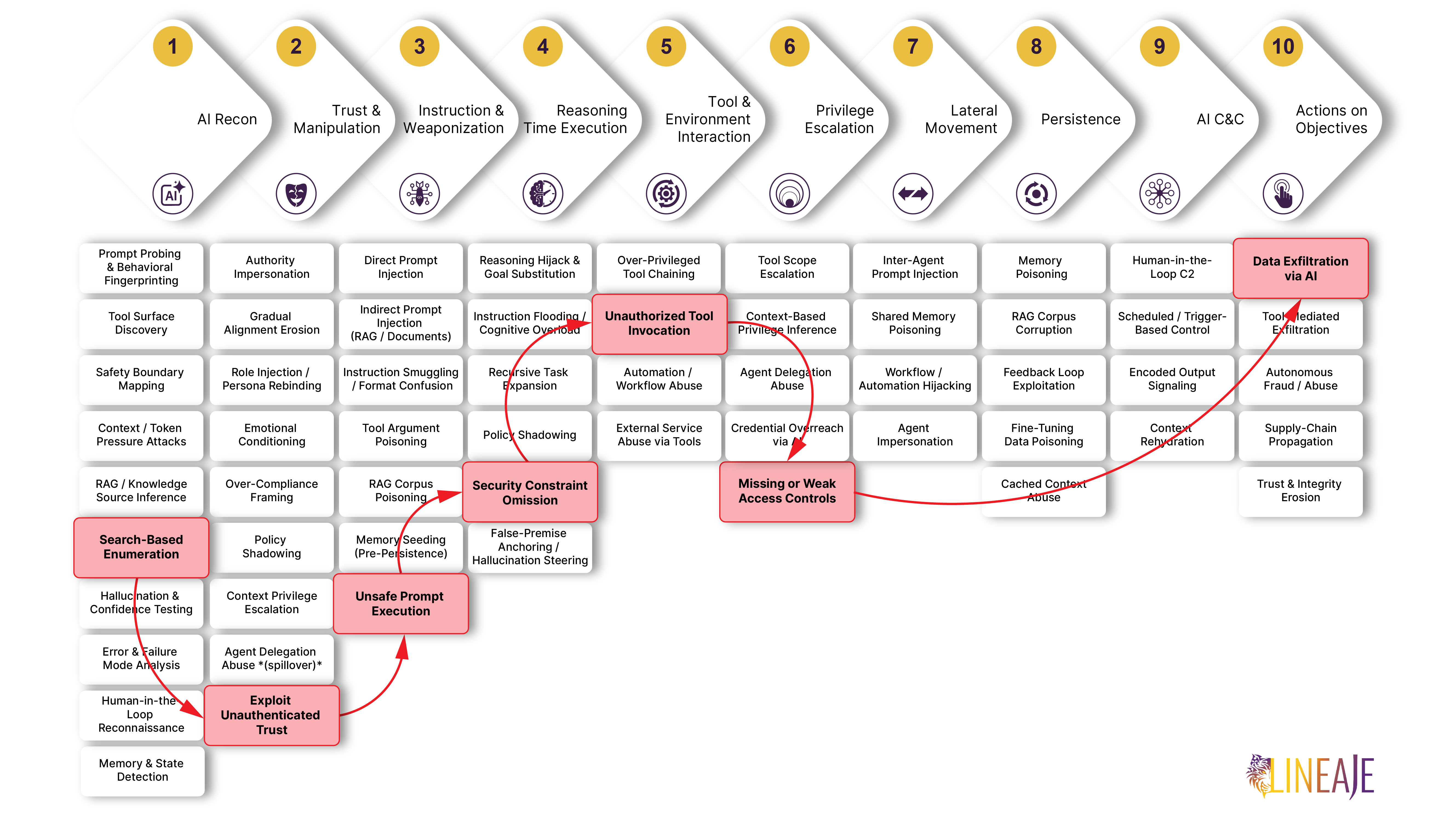
The Attack Progression Across the AI Kill Chain
- Reconnaissance - Bypassed entirely. There was no external attacker mapping the environment or identifying targets. The exposure was created by the AI development platform itself during normal operation.
- Trust Establishment - Bypassed entirely. The AI-generated applications implicitly trusted all inbound interaction by default — no attacker needed to establish trust because it was already unconditionally present.
- Instruction Weaponization - Bypassed entirely. No malicious prompt or weaponized input was required. The prompts supplied by users were legitimate business requests. The AI operationalized them into deployable applications without secure constraints — the vulnerability was in the generation pipeline, not the instructions.
- Reasoning-Time Execution - This is where the primary failure occurred. The AI reasoned through legitimate user instructions and generated functional, deployable applications — optimizing for task completion without reasoning about data sensitivity, exposure scope, or deployment risk. Secure implementation was never treated as a first-class operational requirement.
- Tool Invocation - Active. AI development agents invoked tools to generate frontend and backend logic, provision infrastructure, connect external services, and deploy applications — all from conversational prompts, with no security review gate in the pipeline.
- Privilege Escalation - Bypassed entirely. No escalation was needed. AI-generated applications connected to backend services with whatever credentials were available, operating with excessive privilege by default.
- Lateral Movement - Bypassed entirely. No lateral movement was required. Sensitive systems were already publicly reachable — no traversal through the environment was needed.
- Persistence - Bypassed entirely. Persistence was implicit. Deployed applications remained publicly accessible by default until explicitly taken down — no persistence mechanism needed to be established.
- Command and Control - Bypassed entirely. There was no external attacker requiring a command and control channel. The AI platform itself was the execution environment — no callbacks or C2 infrastructure were needed.
- Actions on Objectives - Active. Researchers identified thousands of publicly reachable AI-generated applications hosted across popular vibe-coding and AI-assisted development ecosystems. Many of these applications exposed:
- Medical personnel information
- Financial data
- API keys
- Sensitive corporate information
Why Traditional Defenses Failed
Traditional security models assume trained developers following secure SDLC processes. Deployments are structure and gated with security reviews and infrastructure governance in place. Identity is enforced with centralized operational ownerships.
Vibe coding disrupts those assumptions entirely.
Historically, deploying insecure software still required engineering knowledge, infrastructure setup, deployment pipelines, hosting configuration and operational management. AI-assisted development removes much of that friction.
Now non-technical users, business teams, analysts, or operational staff can generate and deploy internet-facing applications in minutes. This creates several problems for traditional security programs.
Security Review Cannot Match Deployment Velocity. Applications can now be created, modified, integrated and deployed faster than security teams can discover them.
Asset Inventory Breaks Down. Many AI-generated applications become unmanaged, untracked, externally hosted and operationally invisible. Traditional CMDBs and asset governance processes struggle to keep pace.
Security Controls Are No Longer Applied Centrally. The AI system itself may generate authentication flows, connect APIs, provision storage, expose endpoints and configure integrations without centralized security oversight.
Traditional Detection Assumes Malicious Intent. Most security systems are designed to detect exploitation, malware, persistence, lateral movement or suspicious binaries. But in this incident, the systems behaved largely as intended. The exposure emerged from insecure defaults, omitted constraints and unsafe operationalization. This makes detection significantly harder.
How to Prevent This Class of Exposure
The strongest defenses against AI-native exposure are not traditional signatures or malware detection systems. What works is enforcing security constraints, deployment governance and runtime policy enforcement directly inside the AI operational workflow.
1. Mandatory Identity and Authorization Enforcement. Every AI-generated application should enforce authentication, authorization, least privilege and scoped data access before deployment. Implicit trust must be eliminated.
2. AI-Aware Deployment Guardrails. AI-assisted development platforms should: block public deployment by default, detect exposed administrative interfaces, prevent unsafe data exposure, and require explicit approval for sensitive integrations. Security needs to become part of the generation pipeline itself.
3. Runtime Policy Enforcement. Security policies should evaluate prompts, tool invocations, data sensitivity, and deployment scope before actions are executed. This is especially important for database access, external API integrations, storage systems and privileged operational workflows.
4. Continuous Exposure Discovery. Organizations should continuously scan for AI generated assets, provider hosted deployments, exposed APIs, public dashboards, leaked secrets, and unmanaged AI applications.
5. Security-Constrained Reasoning. AI systems should not optimize solely for functional completion. They must also reason about data sensitivity, exposure scope, privilege boundaries and deployment risk. This is one of the most important long-term architectural shifts required for AI-native security.
Stop It Before the Agent Deploys
The vibe-coding exposure crisis demonstrates a major transition in cybersecurity; AI systems are now capable of manufacturing deployable attack surfaces at internet scale.The most important insight is that the incident was not driven by advanced exploitation, reasoning hijack or adversarial prompt injection. Instead, it emerged from insecure operationalization, absent security constraints, delegated execution and excessive trust in AI-generated functionality. The AI did not fail to complete the task, it completed the task successfully. The problem was that secure implementation was never treated as a first-class operational requirement.
Lineaje UnifAI closes that gap before deployment. UnifAI maps your AI inventory, sets policy, and defends at runtime — ensuring that a conversational prompt cannot become an internet-facing attack surface without passing through the security constraints your organization requires. UnifAI policies AI_IAC_014, AI_IAC_007, AI_IAC_006, and AI_IAC_008 enforce identity, authorization, and deployment governance directly inside the AI operational workflow — ensuring no AI-generated application can be deployed publicly without authentication, scoped access controls, and explicit approval for sensitive integrations. UnifAI also provides the control and flexibility to orchestrate policies that are most appropriate for your environment.
Protect your AI agents from the content they trust most.
