
AI has made finding vulnerabilities cheap. Exploiting them easier. Fixing them is still expensive.
For CPOs, CISOs, CIOs and CEOs, the gap between finding and fixing is where the risk now lives.
In its first month, Anthropic’s Project Glasswing pointed a frontier model, Claude Mythos Preview, at partner systems and open-source code and surfaced more than 10,000 high- or critical-severity vulnerabilities. By Anthropic’s May 22, 2026 update, 530 of the high- and critical-severity open-source bugs had been reported to maintainers. Only 75 had been patched.
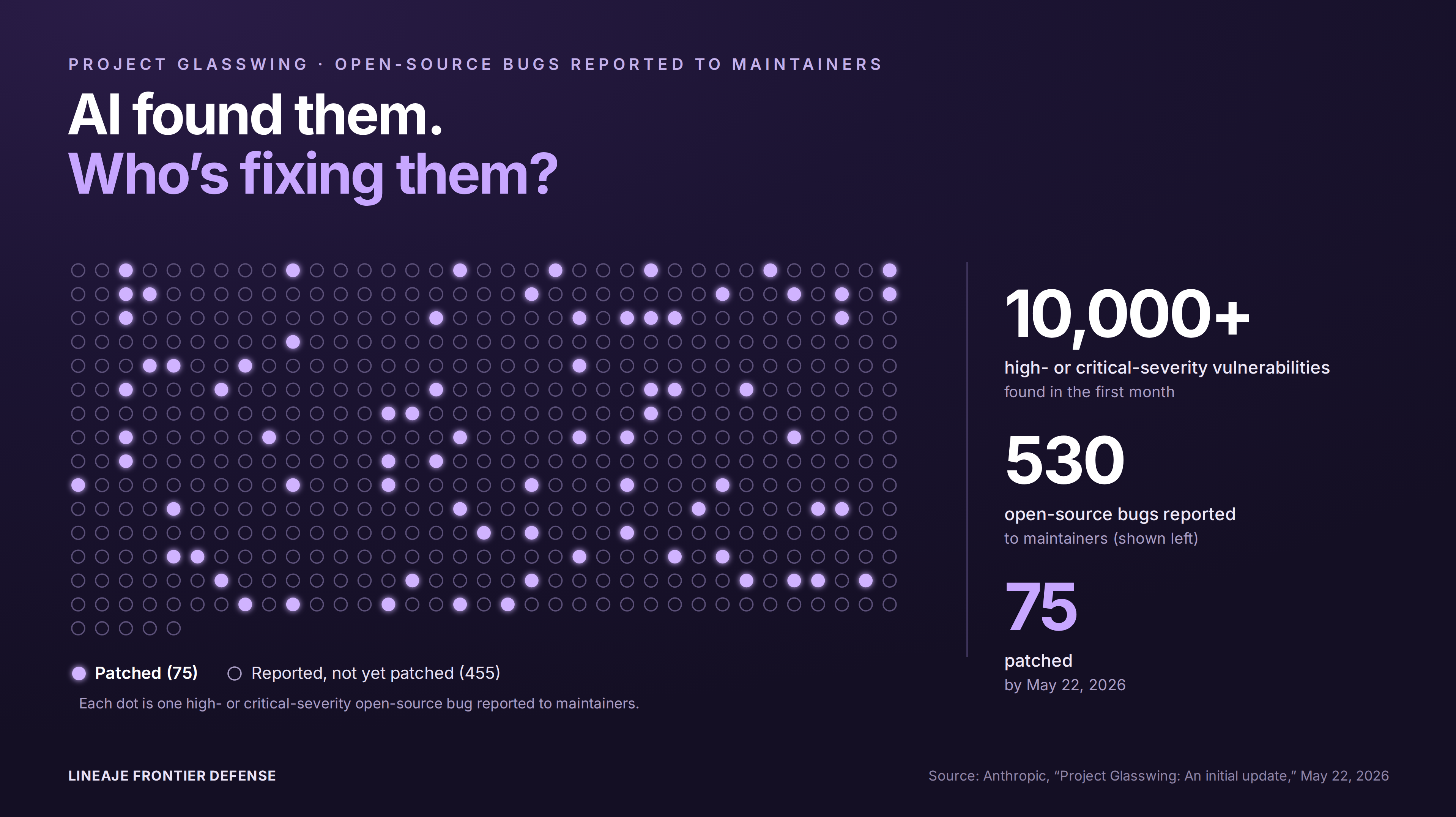
That ratio is the story of application security in 2026. Finding vulnerabilities has become a compute problem. Fixing them is still a people problem, and people don’t scale on the same curve as GPUs.
As findings explode, fixing them at the speed of code change can’t stay a people problem.
Four changes are arriving at the same time, and each one makes the others worse.
For a decade, the AppSec question was “How many findings do we have?” Prioritization tools answered it, mostly by producing well-argued reasons why most findings could wait.
That approach assumes reachability and exploitability hold still. They don’t. Every commit can change what’s reachable, and every new model changes what’s exploitable. The question leadership now asks has three parts:
A severity score answers none of these. A reproduced exploit, a patch and a re-run of that exploit against the patch answer all three.
Mythos won’t be the last frontier model. Better models will keep arriving, each with different strengths in code reasoning, exploit generation, context handling and remediation. There are already better frontier models that can ‘find’ at a cheaper cost. Committing a security program to one model is like having a single friend.
The lasting capability is model flexibility: bringing new commercial and open-source models into a controlled workflow and turning whatever they find into verified fixes.
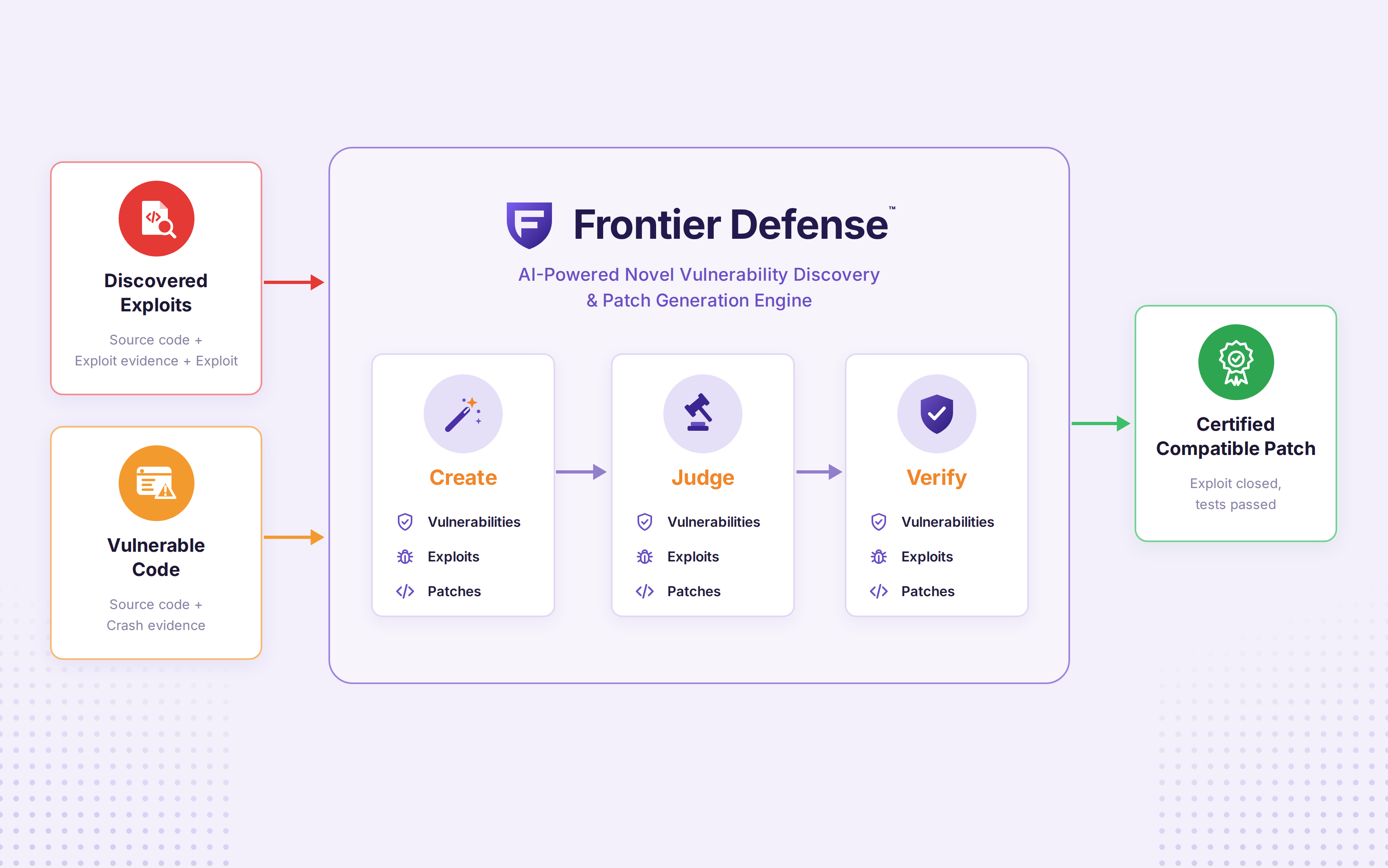
Lineaje Frontier Defense™ is an AI-native security intelligence engine that continuously discovers novel vulnerabilities, validates exploitability, generates verified exploits, creates compatible patches, and verifies successful remediation at scale. Frontier Defense adds an autonomous, multi-agent AI harness that orchestrates the discovery, validation, verification, and remediation of novel vulnerabilities in first-party code. It leverages multiple frontier AI models, such as Opus and Fable, with Mythos where access allows, to continuously assess code in any Git repository.
Lineaje Frontier Defense overlays the AppSec tools you already run, including SAST, SCA and container scanners, and adds frontier-model scanning where you don’t have it. The job is simple to state: take vulnerable code in and send verified patches out.
Under the hood, an autonomous harness spins up and tears down nine isolated AI sandboxes. Each stage of the pipeline has three roles:
Exploits are detonated in gVisor-based, network-isolated, single-use containers with no egress, and memory-safety exploits are confirmed with ASAN-instrumented crash validation. The patch loop iterates up to five times per finding. Humans are needed at one point: approving the pull request.
WordPress is one of the most widely deployed and most scrutinized PHP codebases, which makes it a hard test. We scanned the WordPress 6.9.4 source (GitHub tag, March 11, 2026) and the official wordpress:6.9.4 container image from Docker Hub.
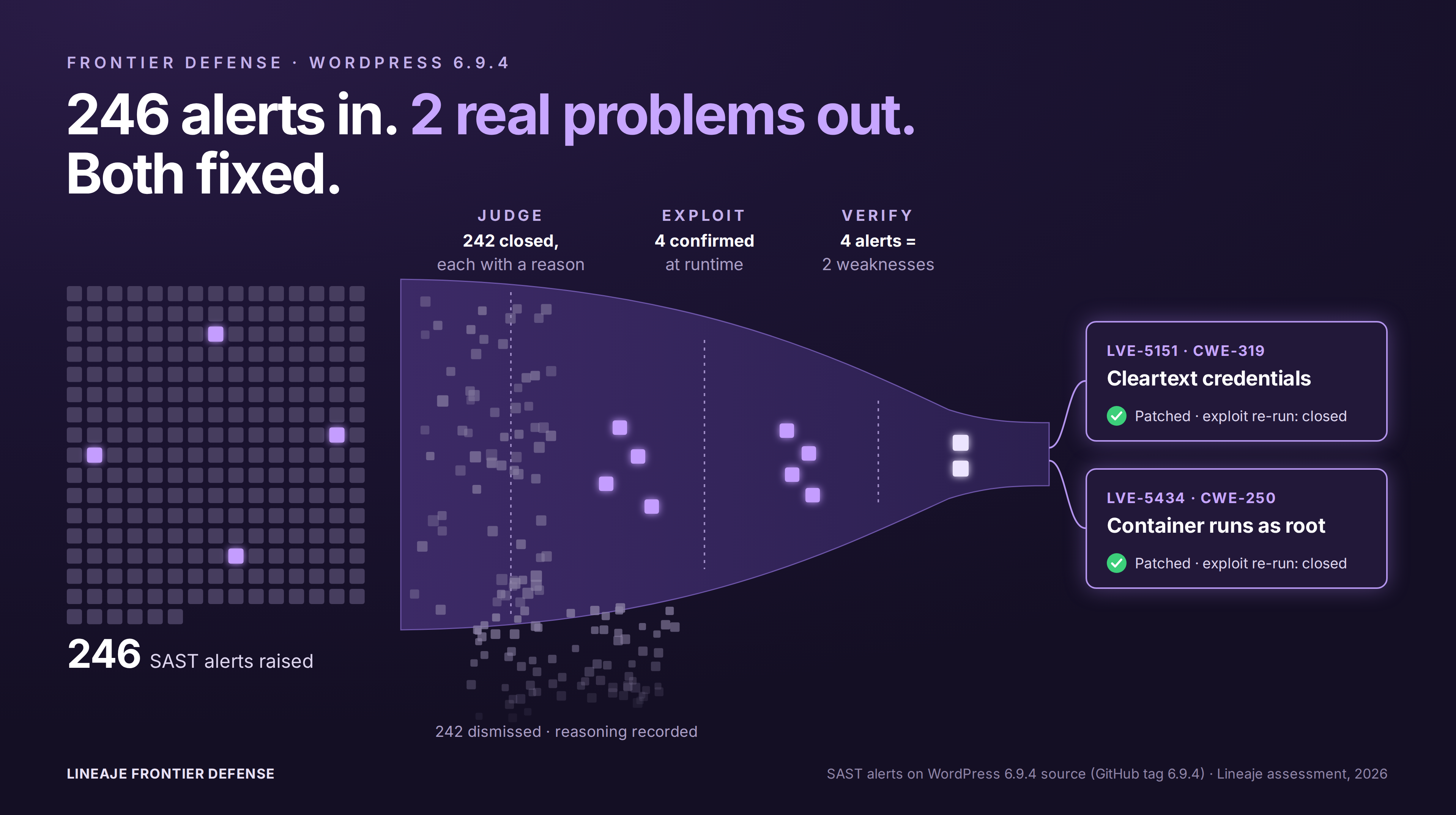
A standard SAST ruleset raised 246 alerts: 193 in PHP, 50 in JavaScript, 2 in package-manager configuration and 1 in the Dockerfile. Without triage, that’s 246 tickets for developers. Frontier Defense checked every one.
| SAST signal class Raised Verified Why the rest were closed | |||
| PHP file deletion (unlink-use) | 58 | 0 | Paths generated by wp_tempnam(), confined to a server temp directory |
| PHP SQL injection (tainted SQL string) | 52 | 0 | Parameterized through $wpdb->prepare() or integer casts |
| JavaScript non-literal RegExp | 30 | 0 | Editor-internal input, not reachable by an attacker |
| PHP transport-security rule | 23 | 3 | 20 closed; 3 verified as one exploitable weakness |
| PHP tainted filename sinks | 23 | 0 | Path construction validated upstream |
| Prototype pollution, unserialize, exec and 13 other rules | 59 | 0 | Inputs not attacker-controlled, gated or static |
| Dockerfile runs as root (missing-user) | 1 | 1 | Verified |
| Total | 246 | 4 | 242 closed, each with a recorded reason |
Table 1. WordPress 6.9.4 SAST alerts after Frontier Defense adjudication. The full per-alert record, with verifier reasoning, is available on request.
That’s 98.4% of the noise closed with a written reason, not a suppression flag. A typical example: the unlink-use rule fired 58 times. Frontier Defense traced whether a caller could ever control the deleted path. It can’t. WordPress passes the name through basename() and wp_tempnam(), so an input of ../../etc/passwd becomes /tmp/passwd-<random>.tmp. The file you wanted to delete stays exactly where it is.
The 4 verified alerts reduce to 2 distinct weaknesses, both of which Frontier Defense exploited, patched, and re-tested.
A WordPress core component can transmit administrator credentials and file contents without encryption under a common configuration. An attacker on the network path can read both. Three separate SAST alerts pointed at this one weakness.
The fix: Frontier Defense reproduced the exploit, generated a patch, and re-ran the exploit against it: closed, with normal operation unaffected. We reported the issue to the WordPress security team. We’ll publish technical details once coordinated disclosure is complete.
The container definition inherits the root user from its PHP base image and never sets a USER directive, so the application process runs as UID 0. Container root isn’t automatically host root, but it turns any other bug in the stack into full control of the container, and it amplifies every misconfigured mount or excess capability. Everyone who deploys that container inherits the problem.
The fix: a single line, USER www-data, before the container starts. After the rebuild, the exploit could not regain root.
The source code isn’t the whole attack surface. The official wordpress:6.9.4 image carries 156 critical, high or exploitable CVEs in its operating system packages and runtime utilities, none of which appear in a scan of WordPress’s own code. Frontier Defense fixed all 156 automatically, using Lineaje Gold Open Source packages.
| WordPress 6.9.4 Without Frontier Defense With Frontier Defense | ||
| SAST alerts sent to developers | 246 | 0 (242 closed with reasons) |
| Verified exploitable weaknesses | Unknown | 2 (4 alerts), all patched |
| Container CVEs sent to developers | 156 | 0 (156 fixed automatically) |
| What developers receive | 402 tickets | Verified fixes and one PR for review |
Table 2. The developer’s view, before and after.
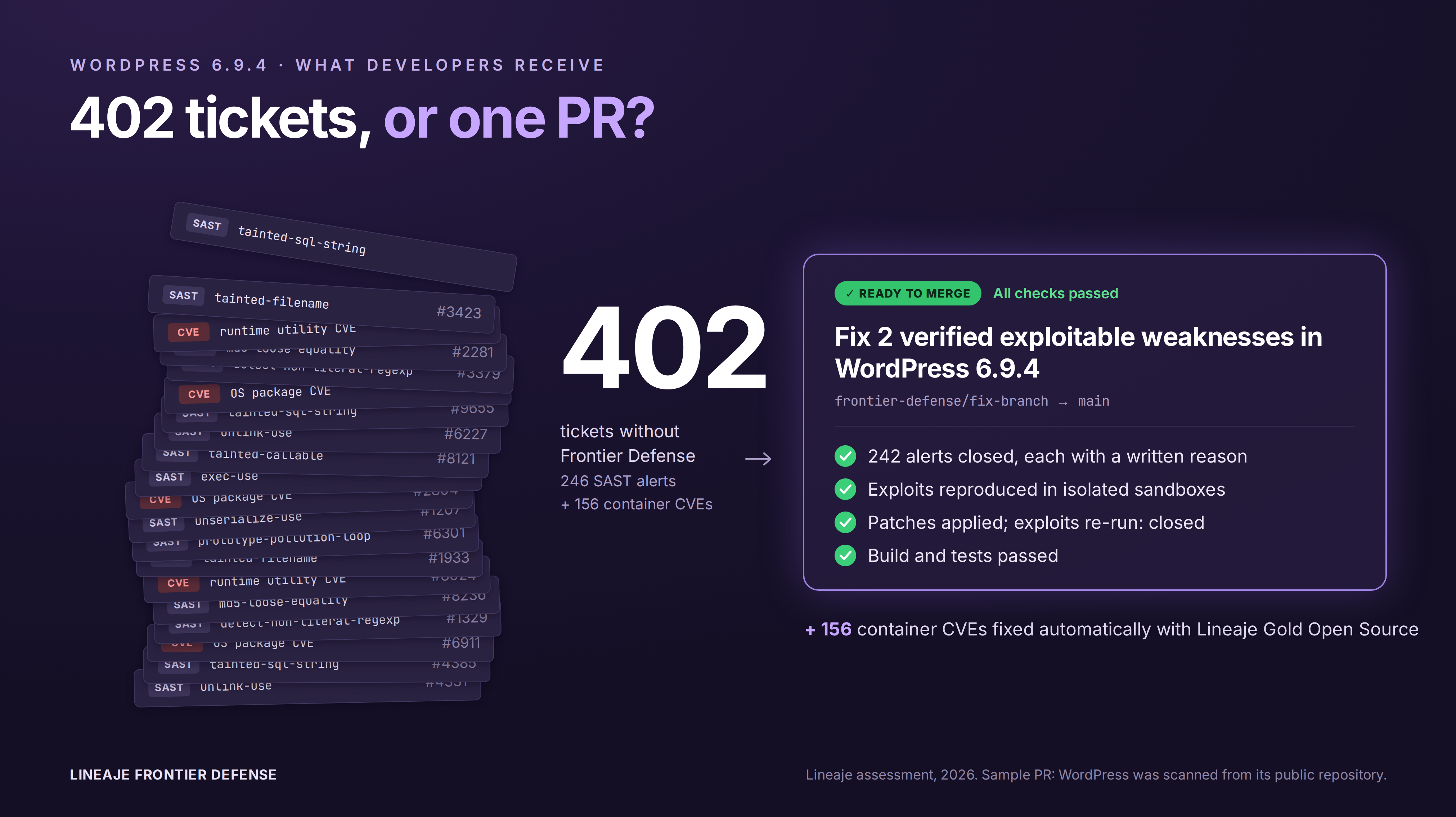
All fixes land in a fix branch, each followed by a build and test run to confirm the application still works. The pull request is raised only after every fix passes. (Because WordPress was scanned from its public repository, the pull request was produced as a sample rather than submitted.)
SAST handed developers 246 tickets. Frontier Defense handed them 2 real problems, already fixed.
WordPress isn’t an outlier. Across 29 Python, Java, and C++ projects, Frontier Defense produced these results:
| Novel findings Reachable or exploitable Verified exploits Patches | |||
| 165 | 79 | 22 | 21 unique patches closed all 22 |
Table 3. Frontier Defense results across 29 projects.
Three numbers in that table matter most:
Across the CVEF, Lineaje customers eliminate 85% of developer toil on vulnerability remediation.
AI has compressed the time between discovery and exploitation, and regulators have compressed response windows to match: 12 hours in India, 24 in the EU. The operating model has to compress with them: test continuously with frontier models, verify what’s exploitable, patch what matters, and keep the proof for engineering, customers, auditors and regulators.
Frontier Defense is built for that model. Point Frontier Defense at one project and see how quickly your team moves from vulnerable code to verified, evidence-backed patches.
Try it. Eliminate exposure in your first-party code at the speed of AI.
WordPress and 29-project results are from Lineaje's internal assessment